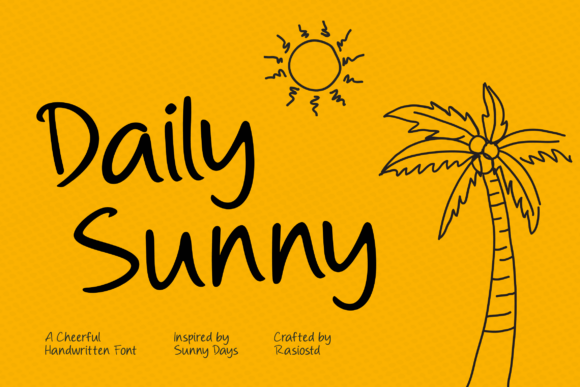
Daily Sunny: The Handwritten Script Font That Feels Like a Bright Day
There's a particular quality to handwriting that digital type often struggles to capture—the slight irregularity, the personal touch, the sense that a real person put pen to paper. Daily Sunny manages to bottle that feeling. This script font draws its inspiration from relaxed creative mornings and the kind of effortless flow you get when you're doodling without pressure. The strokes move with a natural rhythm, curving and looping in ways that feel genuinely human rather than mechanically perfect.
What makes Daily Sunny stand out among handwritten fonts is its balance. Some script typefaces lean too far into casual territory and sacrifice legibility. Others become so polished they lose their warmth. Daily Sunny sits comfortably in between. The letterforms are smooth but not stiff, playful but not childish. Each character carries a friendly energy that translates well across different design contexts, from a small business logo to a social media post that needs to stop someone mid-scroll.
Where Daily Sunny Truly Shines
Think about the last time a piece of packaging design caught your eye at a store. Chances are, the typography played a significant role. Daily Sunny works exceptionally well for products that want to convey authenticity and approachability. Artisan food brands, handmade cosmetics, boutique candle companies—these are the kinds of businesses where a creative font like this one can elevate the entire visual identity. The handwritten quality signals that something was crafted with care, not mass-produced on an assembly line.
For social media graphics, Daily Sunny brings personality to quotes, announcements, and promotional posts. Instagram stories, Pinterest pins, and Facebook headers all benefit from type that feels personal rather than corporate. When you're competing for attention in a crowded feed, a font with genuine character can make the difference between someone pausing to read and someone scrolling past.
Greeting card designers will find Daily Sunny particularly useful. The font's natural flow mimics the feel of someone writing a heartfelt message by hand. Wedding invitations, birthday cards, thank-you notes, and holiday greetings all benefit from this kind of warmth. The same quality extends to editorial design—think lifestyle magazine headers, blog post titles, and chapter openers that need a touch of personality without sacrificing readability.
Branding and Logo Applications
Choosing a typeface for logo design is one of the most consequential decisions in building a brand identity. The font becomes the visual voice of the business, appearing on everything from business cards to storefront signage. Daily Sunny works best for brands that want to project warmth, creativity, and approachability. A yoga studio, a children's clothing line, a neighborhood bakery, a freelance photographer—these are businesses where customers expect a personal connection.
The key is matching the font's personality to the brand's values. If your business thrives on relationships and authenticity, a handwritten font like Daily Sunny reinforces that message visually. If your brand leans more corporate or technical, a clean sans serif font might serve you better. Typography is about alignment between what you say and how you present it.
Working With Font Pairings and Design Hierarchy
No font exists in isolation. Professional modern typography relies on thoughtful combinations—pairing a display font with a supporting typeface that handles body text and secondary information. Daily Sunny performs best as the headline or accent font. Its expressive nature makes it ideal for titles, pull quotes, call-to-action buttons, and featured text where personality matters most.
For supporting text, consider pairing it with a clean serif font or sans serif font. A straightforward typeface like a geometric sans serif creates a pleasing contrast, letting Daily Sunny's organic curves stand out without overwhelming the layout. This kind of pairing also addresses readability concerns. While Daily Sunny is legible at larger sizes, extended paragraphs of body copy are better served by type designed specifically for sustained reading.
When testing font pairings, pay attention to x-height, weight, and spacing. Daily Sunny's casual baseline and moderate weight pair well with typefaces that have similar proportions. Avoid combining it with overly ornate or decorative fonts, which can create visual clutter. The goal is contrast with harmony, not competition between styles.
Practical Considerations Before You Commit
Before integrating any premium font into a project, take time to evaluate the full character set. Check whether Daily Sunny includes the punctuation, numerals, and special characters your project requires. If you work in multiple languages, verify that the necessary accented characters are available. Review any alternate letterforms or stylistic sets the font offers—these variations can add subtle diversity to your typography and prevent repetitive letter shapes from becoming noticeable.
Readability testing is non-negotiable. Set sample text at the sizes you'll actually use and view it on different screens and in print if applicable. A font that looks beautiful in a headline might become difficult to read at smaller sizes, especially in web design where screen resolution and rendering vary across devices. Daily Sunny's clean strokes hold up reasonably well, but always verify against your specific use case.
Licensing matters for any commercial font. Confirm that the license covers all your intended applications—whether that's a client project, merchandise, digital products, or print materials. Most design assets come with specific terms, and understanding them upfront prevents complications later. Keep your license documentation organized and accessible, especially if you're working with clients who may need verification.
Making the Most of a Creative Font
The best typography decisions come from experimentation. Set your actual content in Daily Sunny rather than relying on placeholder text. Type out your real headlines, your actual brand name, your specific product descriptions. This reveals how the font handles your particular letter combinations and word lengths. Some scripts create awkward connections between certain letter pairs—testing with real content surfaces these issues early.
Consider the broader context of your project. A packaging design for an organic skincare line has different typographic needs than a fitness brand's Instagram campaign. Daily Sunny adapts to various contexts, but the supporting design elements—color palette, imagery, layout structure—should work together with the font to tell a cohesive story. Typography doesn't exist in a vacuum. It's one voice in a larger conversation between all the visual elements on the page.
For small business owners and independent creators, investing in quality design assets like a well-crafted font can elevate your visual presence significantly. Daily Sunny offers the kind of personality and polish that helps bridge the gap between amateur and professional design. Whether you're building a brand identity from scratch or refreshing an existing one, a font that genuinely reflects your business's character is worth the investment.